
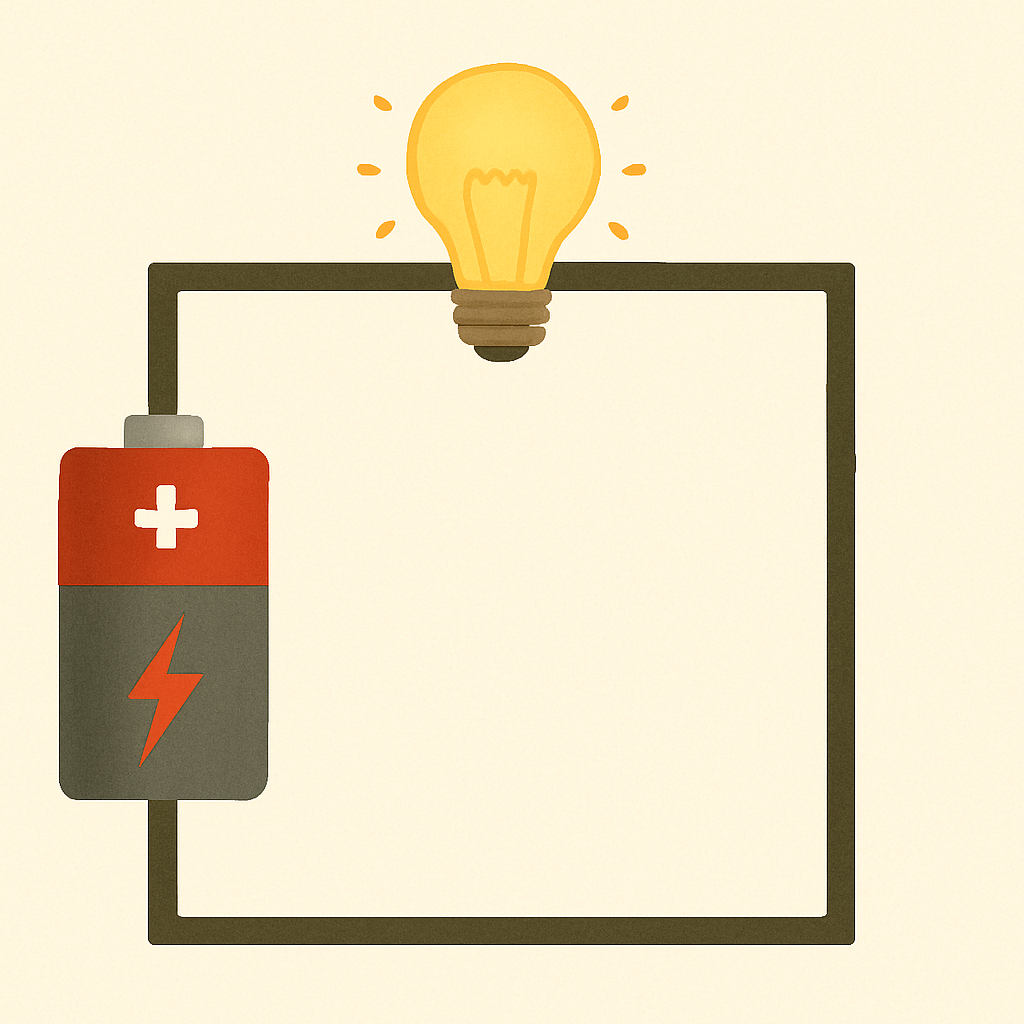
When you use a battery, one end is marked with a minus (–) and the other with a plus (+). Electric current is always shown in diagrams as flowing from plus to minus because that is what people agreed on long ago when they did not yet know how particles move. However, we now know that electrons exist – these are small particles that generate electricity and actually move from the negative to the positive, contrary to what is shown in diagrams. But the old direction has remained in use in drawings so that everyone around the world understands it in the same way.
If electricity comes from a power plant, the same principle applies – one wire acts as the negative pole and the other as the positive pole. This difference creates a “push” that causes electricity to move.
For this energy to reach the light bulb, the circuit must be closed – only then can the electricity flow in a circle.
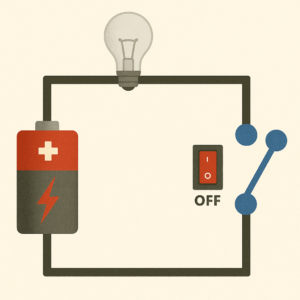
Imagine that an electrical circuit is like a road for cars. If the road is broken somewhere, no one can drive on it. The same applies to an electrical circuit.
When the switch is off, the path is not closed, and the electricity cannot reach the light bulb. It simply waits at the “barrier.”
The result? The light bulb does not shine because the electricity has not reached it.
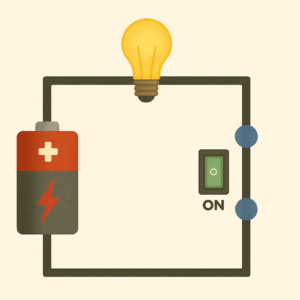
Now, press the switch. What have you done? You have completed the entire path through which electricity can flow. Now the circuit is closed—it’s like a continuous path from start to finish.
Electricity begins to flow through the wires, passes through the bulb, and voilà—light! This means that the entire circuit is working and energy is flowing consistently, in a circle.